Can Your Child Catch Up in One School Holiday?
23 August 2026
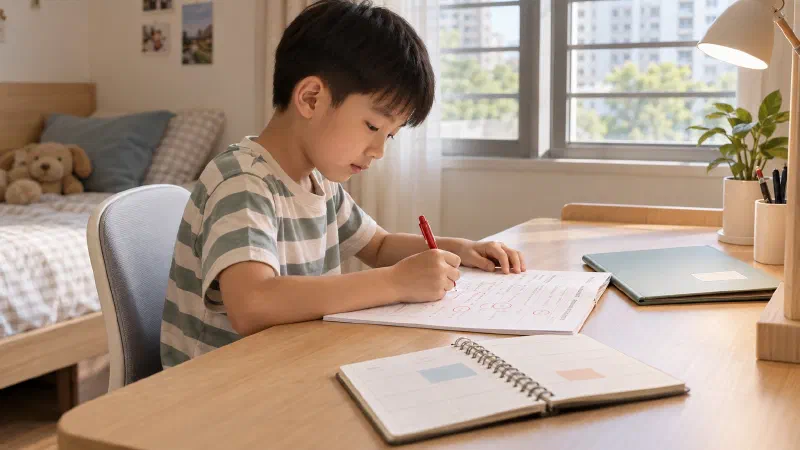
Boy correcting one worksheet beside a closed subject folder.
Catching up needs a smaller definition
When a child has fallen behind, a school holiday can feel like the obvious time to recover everything. Without daily lessons, parents may expect the child to complete missed work, revise weak topics and begin the next term fully prepared.
One week rarely has enough space for all of that. It can still help if catching up means resolving a small number of important gaps rather than erasing an entire term’s difficulties.
Separate urgent gaps from accumulated work
Not every unfinished page represents an equally important learning need.
Look for gaps that affect what comes next. A misunderstood method that appears repeatedly may deserve attention. An incomplete optional worksheet may not. Teacher feedback and recent attempts can show which problems are continuing to interfere with the child’s work.
This prevents the holiday plan from becoming a list of everything that was not completed earlier.
Choose work that can produce a visible change
A useful target is specific enough to explain, practise and check again.
For example, the child might revisit one Maths method, correct a set of related errors and attempt two fresh questions. By the end, both parent and child can see whether the gap has narrowed.
“Catch up on Maths” has no equivalent stopping point. It encourages work to expand while making progress difficult to recognise.
Do not compress a term into a week
Trying to recover months of learning usually creates long sessions and repeated conflict. The child may rush through tasks to finish the list without understanding more than before.
Study load is a real limit. Rest, family commitments and ordinary holiday time still matter, especially if tiredness contributed to the earlier difficulty.
If several major gaps remain, use the holiday to identify and begin the most important one. The others need a sustainable school-term plan.
End with evidence, not a promise
At the end of the break, check what has changed. Can the child now explain the idea or complete a similar question with less support?
That evidence determines the next step. A resolved gap can move to occasional checking. An unresolved one may need teacher support or a different explanation.
A short holiday can create useful movement. It should not be judged by whether the child has somehow caught up on everything.