Does Starting Early Mean More Practice Papers?
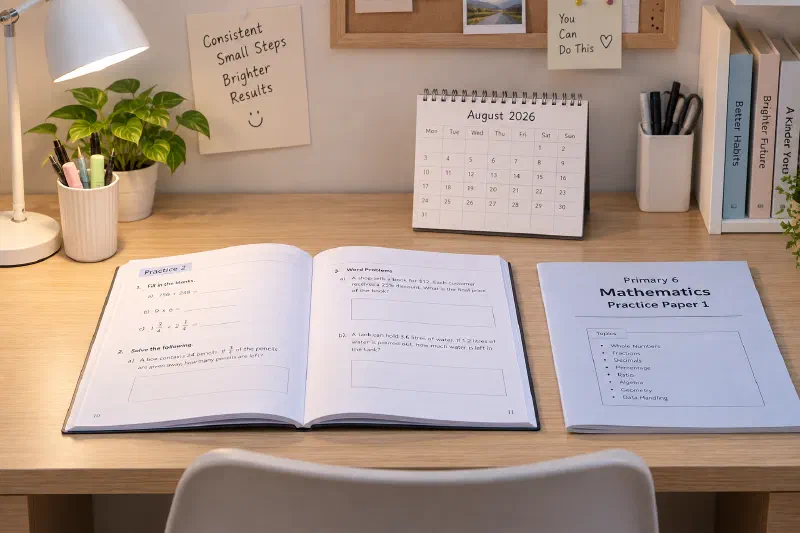
A practice paper beside an open workbook and calendar.
More preparation time does not require more full papers
Starting earlier can easily become a question of quantity.
If a child has more months available, it may seem sensible to begin completing practice papers sooner and continue doing them for longer.
But a full paper is designed to bring many demands together. It may test material from different topics, require the child to choose methods independently and place some pressure on pacing and attention.
Those demands are useful only when they match what the child is ready to practise.
Earlier preparation should first create room to build the knowledge and processes that later make practice papers worthwhile.
A practice paper reveals problems more readily than it fixes them
Completing a paper can show that a topic is weak, a question type is unfamiliar or time is being used poorly.
That information matters. The paper has acted as a broad check.
The improvement usually happens afterwards.
The child may need to relearn a concept, compare two methods, correct a recurring misunderstanding or practise a smaller group of related questions. Giving another full paper immediately may expose the same weakness again without creating enough opportunity to change it.
This is why paper completion and preparation should not be treated as the same activity.
A child can finish many papers while carrying the same errors from one to the next. The volume looks substantial, but the learning between attempts remains thin.
Earlier stages often need narrower work
Before full papers become a regular part of preparation, the child may benefit more from work with a smaller purpose.
Recently taught material needs to be understood. Earlier material needs to be recalled after it is no longer fresh. A weak method may need several focused attempts before it can be selected reliably among mixed questions.
These tasks can look less intensive than a full paper, but they address the parts from which later performance is built.
How Does Retrieval Practice Help With Revision? explains how children can check whether previously learned material is still available without beginning with a broad examination task.
Spaced review serves another purpose. It brings earlier learning back after a gap so that knowledge does not need to be rebuilt only when examinations approach.
Targeted questions then allow the child to work on a specific application or error without the demands of an entire paper competing for attention.
Full papers become useful for broader questions
There is a point at which practising isolated material is no longer enough.
The child needs to choose what knowledge applies without being told the topic. They may need to move between easier and harder questions, sustain attention across sections and make decisions about time.
A full paper can then answer questions that shorter tasks cannot.
Can the child retrieve relevant learning when topics are mixed? Do corrections made in focused practice carry into a broader setting? Does accuracy change as the paper continues? Can the child recover after a difficult question instead of allowing it to affect the next section?
At this stage, the paper has a defined job. It is not being used merely because it looks like serious exam preparation.
Avoid using papers to manufacture urgency
An early start should reduce the need for constant urgency.
If the child is timed, scored and compared against the final standard long before those conditions are useful, the extra preparation period can feel like an extended examination season.
This may also distort what parents notice. A low score on material the child has not yet consolidated can prompt more papers, when the clearer need is to step back and strengthen one part.
The result is a cycle in which broad testing repeatedly confirms problems that narrower teaching and practice have not been given time to address.
Starting early is valuable because the family can slow that cycle down. There is room to identify a gap, work on it and return later to see whether the improvement lasted.
Let evidence determine the next format
The choice between notes, recall, targeted questions and papers should come from the child’s current need.
If the child cannot explain a concept, another full paper is unlikely to be the most direct response. If individual topics are secure but performance becomes inconsistent when they are mixed, broader practice may now be appropriate.
After a paper, look beyond the score. Ask what the attempt revealed and whether the next task should be broad or focused.
More papers are justified when repeated exposure to the complete format is itself the useful practice. Before that point, increasing volume can consume the time that earlier preparation was meant to provide.
Starting sooner should widen the range of useful actions available to the child.
It should not lock the child into the final form of revision before that form has a clear purpose.