Has Your Child Forgotten It or Never Learnt It?
20 May 2026
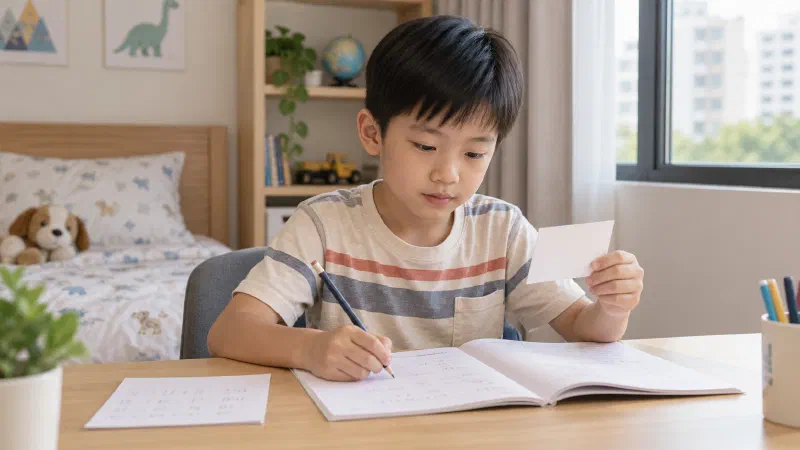
Boy comparing a prompt card with one worksheet.
The same blank answer can have different causes
A child looks at a question and says they cannot remember how to do it.
That may be true. Knowledge that was once secure can become difficult to retrieve after time has passed. But the same response can also occur when the child never understood the idea well enough for it to become usable knowledge.
The distinction matters because the remedies are different. Forgotten learning may need a cue and some retrieval practice. Incomplete learning needs explanation, reconstruction and a fresh check of understanding.
Begin with a small cue
Give the child the least help needed to restart their thinking.
This might be the name of the method, the first step, a diagram without labels or a reminder of a related example. Do not immediately show the full solution.
If the child quickly recovers the rest, explains why the method works and completes a similar question, the knowledge was probably present but temporarily difficult to access. The cue reopened a pathway that already existed.
If the child can copy the prompted step but remains unsure what comes next or why it is correct, the original learning may not have been secure.
Ask for an explanation, not only an answer
A correct answer after prompting does not settle the question.
The child may remember a sequence of steps without understanding the relationship behind them. Ask them to explain the important choice: why this operation is needed, why one variable changes, or why a particular detail from the passage supports the answer.
Someone who has forgotten often recognises the idea as it returns and can reconnect the steps. Someone who never understood may rely on the surface features of the example and struggle when those features change.
Keep the explanation short and specific. The aim is to reveal the state of the knowledge, not to make the child deliver a lesson.
Change one feature of the question
Use a second example that tests the same requirement in a slightly different form.
Change the numbers, rearrange the information or place the idea in another context. If the child can transfer the recovered knowledge, that supports the view that the earlier problem was retrieval.
If performance collapses as soon as the question looks different, familiarity with the original example may have been mistaken for learning. The child may need to rebuild the concept before practising more variations.
One changed feature is enough. A much harder question introduces new demands and makes the diagnosis less clear.
Respond according to the evidence
When the knowledge has been forgotten, ask the child to retrieve it again after a short interval rather than rereading it repeatedly. A few separated checks are more useful than keeping the answer visible throughout one session.
When the knowledge was never secure, return to the first unclear point. Use a different explanation, connect it to prerequisite knowledge and let the child demonstrate the idea with a simple fresh example.
Both situations may eventually involve practice, but practice begins at different points. Forgotten knowledge can often move quickly back into use. Insecure understanding needs to be rebuilt before repeated questions will help.
Check again after the immediate success
Children often perform well immediately after an explanation because the steps are still visible in working memory.
That improvement is encouraging, but it does not show whether the learning will remain available. Remove the supporting example and return to the requirement later.
When Should You Check a Weak Topic Again? explains how a delayed check can show whether the repaired learning has held.
The question is not whether the child once saw the material. It is whether they built knowledge that can be recovered, explained and used when the original teaching is no longer present.