How Can School Holidays Support Exam Revision?
19 May 2026
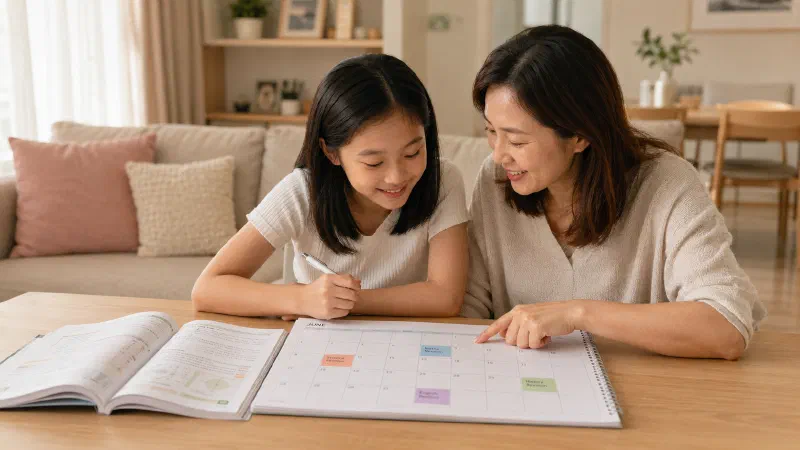
Mother and daughter reviewing a holiday study planner.
A holiday does not need to become an exam camp
School holidays offer more available time, which can make them feel like an opportunity that should be fully used.
Parents may plan daily revision, additional worksheets and an early start on the next term. The schedule looks productive, but it can turn the entire break into a longer version of the school week.
Holidays can contribute to exam preparation without being organised around study from beginning to end.
The useful question is narrower: what would be valuable for the child to consolidate, repair or retain during this particular break?
Once that purpose is clear, revision can occupy an appropriate part of the holiday rather than expanding to fill it.
Decide what the break is for
Different holidays arrive at different points in the learning journey.
One break may follow a demanding assessment period. Another may sit between terms when several earlier topics are beginning to fade. A longer holiday may provide room to address a weakness that was repeatedly postponed during school weeks.
The plan should respond to that context.
If the child is tired and current learning is broadly secure, recovery may be the first need. If one misunderstanding is affecting later work, a small amount of focused attention could prevent it from continuing. If important earlier knowledge has not been used for some time, selective recall may be enough.
A holiday plan becomes excessive when it tries to perform all of these jobs at once.
Consolidate before adding more
Extra time often leads families to introduce new material or harder work.
That may be appropriate in some circumstances, but unfinished learning deserves attention first. A child who still misunderstands a current method gains little from moving ahead simply because the calendar allows it.
Consolidation can involve correcting an assessment carefully, revisiting a topic that remained uncertain or checking whether previously learned material can still be recalled.
This work is less visible than completing many new pages. It is often more useful because it reduces the amount the child will carry unresolved into the next term.
The goal is not to make the child “get ahead” at any cost. It is to begin the next stage with fewer avoidable gaps.
Keep weaker areas specific
“Work on Maths during the holidays” is too broad to guide a session.
A subject may contain both secure and insecure areas. Repeating everything can consume the break while giving too little attention to the actual problem.
Name the limited target. The child may need to reconstruct one method, practise one type of question or correct a recurring error. Once the target improves, it can be checked again later rather than expanded into indefinite daily work.
Specificity also makes the workload easier to judge. Parents can see whether the holiday task is achievable and whether it has reached a sensible stopping point.
Maintenance should remain light
Stronger areas may still need some attention across a longer break.
Maintenance does not require full revision sessions for every subject. A brief recall check, some reading or one mixed exercise may be enough to keep important learning accessible.
If the child can retrieve and apply the material securely, more repetition may add little. That time can return to rest, family plans or the limited priorities that genuinely need work.
This is one reason holiday preparation should not be measured by the number of occupied days. A few well-chosen checks can perform their job without creating a continuous schedule.
Rest is part of the planning decision
The child does not enter a holiday with unlimited attention simply because school is paused.
They may be recovering from assessments, adapting to family commitments or looking forward to time that feels different from term time. Ignoring that reality can produce a plan that exists on paper but creates repeated conflict in practice.
Rest does not need to be earned by completing revision every day. It is one of the legitimate purposes of a school break.
This does not prevent the family from setting aside some study time. It means the work should be bounded. The child should be able to see when revision will happen and when the rest of the holiday is genuinely free.
Give the revision portion a clear shape
A workable holiday plan identifies the priorities, the available days and a reasonable stopping point.
It also leaves room to adjust. Travel, family activities or a task that takes longer than expected should not force the child to carry missed work through the rest of the break.
The PSLE Revision Planner can help place the selected work into the available period while keeping the revision portion visible alongside the days left open.
Do not begin by filling the calendar and then deciding what each session should achieve.
Begin with the small number of outcomes that would make the next term easier. Give those outcomes enough time, preserve the rest of the holiday and stop when the work has served its purpose.