How Can Your Child Build Better Study Habits?
09 June 2026
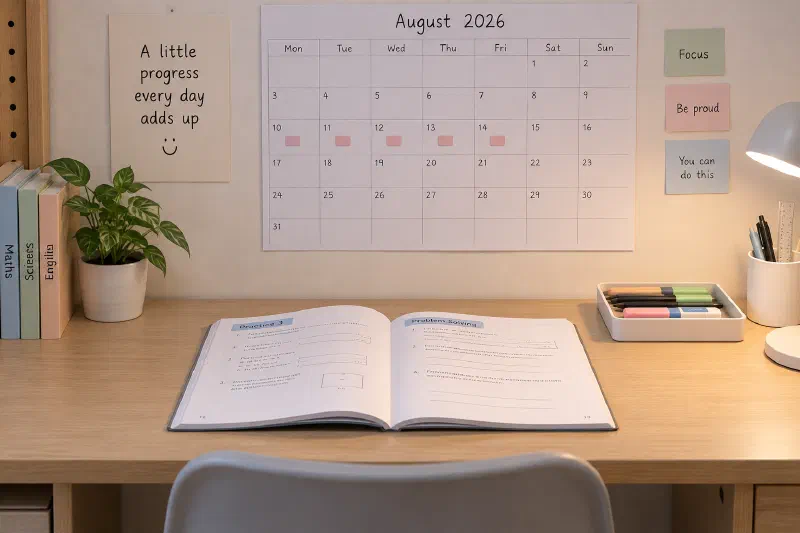
An open workbook beneath a calendar with regular study blocks.
A habit should make useful work easier to begin
Parents often try to build study habits by creating a more demanding schedule.
The child is expected to sit down at a fixed time, cover several subjects and continue even when schoolwork has already been heavy. When the routine breaks, the family may conclude that the child lacks discipline.
A study habit is not valuable merely because it repeats.
It should make a useful action easier to start and more likely to be completed. Before Primary 6, the priority is to establish a small process that works under ordinary conditions—not an intensive routine that survives only through constant reminders.
Make the starting action obvious
“Study after dinner” leaves several decisions unresolved.
The child still has to decide what to study, find the material and work out what to do with it. Each decision creates another point at which the routine can stall.
A clearer habit begins with a visible action. The child may open the current correction folder, attempt a short recall check or continue one identified task from the weekly plan.
The work can vary while the starting process remains stable.
Materials should also have a consistent place. If every session begins with a search for worksheets or stationery, organisation becomes part of the effort required to start.
Reducing this friction is more useful than repeatedly telling the child to be more disciplined.
Keep the routine smaller than the child’s best day
A plan often reflects what the child can do when rested and cooperative.
Habits need to work on more ordinary days too. Homework may take longer, attention may be weaker or another commitment may reduce the available time.
Begin with a routine small enough to repeat without turning each session into a negotiation. The child can complete one meaningful task and stop at a defined point.
This does not set a permanent limit. Once the starting process and follow-through become reliable, the work can expand when there is a reason for it.
Building the largest possible routine first usually creates more opportunities for it to fail.
Attach the habit to a stable cue
A consistent context helps the child know when the action begins.
The cue might be finishing a snack, returning to the desk after a short break or checking the planner at an agreed time. It should fit the family’s actual day rather than an ideal schedule that changes whenever school runs late.
The cue is not meant to remove all choice. It reduces the need to decide from the beginning each time.
If the routine frequently collides with homework, tuition or fatigue, move it. Repeating an unsuitable time does not make the habit stronger; it makes interruption predictable.
Include a response to mistakes
A child can develop the habit of completing work without developing the habit of learning from it.
Useful routines should include what happens after an error or uncertain answer. The child might mark the question for review, check the explanation and attempt it again later.
This response does not need to happen in full during every session. The important point is that mistakes do not disappear when the page is closed.
Over time, the child learns that completing a task includes noticing what requires another action. That habit will matter when Primary 6 produces more marked work and competing priorities.
Let the child manage one part
A routine controlled entirely by reminders belongs mainly to the parent.
The child can gradually take responsibility for preparing the materials, marking completion or choosing between two agreed tasks. These are small opportunities to practise follow-through.
Parents should remain involved where the process is not yet reliable. The question is which support still solves a real problem and which part the child can now attempt.
How Much Should Parents Help With Exam Revision? looks more closely at how structure can remain available while responsibility moves towards the child.
Review the routine when it repeatedly fails
Consistency does not mean preserving a poor plan.
If the child rarely starts, the cue may be unclear or the materials difficult to access. If sessions regularly overrun, the task may be too broad. If the child completes the routine but retains little, the study method may need to change.
Treat these failures as information about the design of the habit.
Changing the starting time, shortening the task or making the next action more specific may improve consistency more than adding consequences or supervision.
Build something Primary 6 can use
The best pre-Primary 6 habit is not necessarily daily intensive revision.
It is a repeatable sequence the child understands: recognise the time to begin, locate the material, complete a defined task and identify what needs another response.
That sequence can later support a larger revision plan because the child is not learning every part of the process for the first time.
Start with a routine that fits real family life and produces useful work. Strengthen it through repetition, then expand it only when the child’s needs justify the change.