How Can Your Child Reset After a Bad Revision Day?
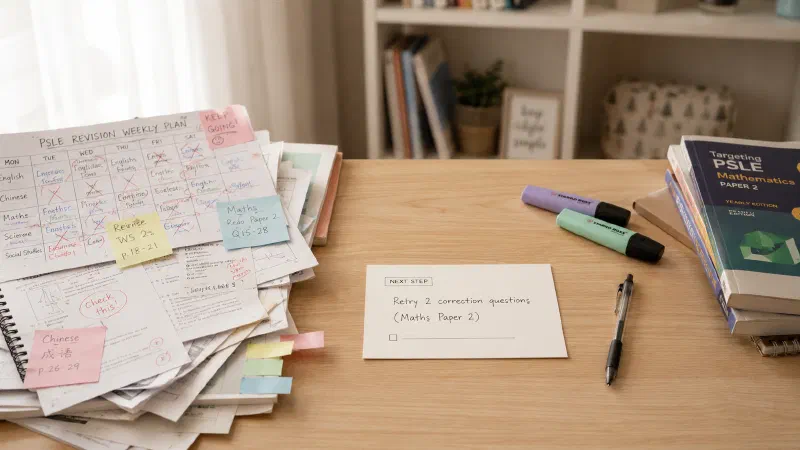
An unfinished revision list set aside beside one clear task for the next day.
One difficult day does not define the revision period
Some revision days simply go badly.
Your child sits down but cannot concentrate. A task that should have been manageable takes far longer than expected. A difficult question leads to frustration, and the rest of the session unravels.
When PSLE is getting closer, a day like this can feel expensive.
The instinct may be to recover the lost work immediately. The unfinished tasks are moved to the next day, another session is added, or the child is told that the time must be made up over the weekend.
But one poor session does not usually threaten the entire revision plan.
The response can create a larger problem if the child begins the next day carrying both the unfinished work and the emotional weight of having failed the previous one.
A reset should help the child return to useful action. It does not need to erase the fact that the bad day happened.
Let the session end before trying to repair it
When concentration has collapsed or frustration is rising, continuing is not always productive.
The child may still be sitting at the desk, but the quality of the work can fall sharply. Instructions are reread without being understood. Simple mistakes increase. Corrections become rushed or argumentative.
At that point, insisting on finishing the original task can turn revision into a contest over endurance.
Sometimes the better decision is to stop, take a proper break or end the session for the day.
This is not the same as allowing every difficult task to be avoided. It is recognising that the current attempt is no longer doing useful work.
The cause can be examined once both parent and child are less frustrated. Trying to diagnose the problem in the middle of an argument rarely produces the clearest answer.
Find out what made the day difficult
“I could not revise today” can describe several different situations.
Perhaps the child was tired after school. Perhaps the planned task was too large. Perhaps one topic felt so confusing that they did not know how to begin. Perhaps the day already contained tuition, homework and other demands.
There may also be no deep explanation. Attention varies, and an occasional poor day can simply be an occasional poor day.
Look for the smallest useful account of what happened:
- Was there enough time for the task?
- Did the child know what to do first?
- Was the work at an appropriate level of difficulty?
- Did tiredness or frustration appear before revision began?
- Is the same problem happening repeatedly?
The aim is not to conduct an investigation into every lost minute.
It is to decide whether tomorrow needs a different plan.
Do not turn unfinished work into automatic debt
Moving every missed task forward can make the next day unrealistic before it begins.
Suppose your child planned to complete Science corrections and an English exercise but did neither. Adding both tasks to tomorrow’s existing Mathematics and Mother Tongue work may protect the original list, but it does not create more time or energy.
Choose what should happen to the unfinished work.
One task may still be important enough to move. Another may be shortened. A lower-priority activity may be dropped. The current day’s plan may need to make room.
Revision is full of competing priorities. A schedule that cannot release or reshape a task will eventually become a record of everything the child has failed to complete.
The goal is to preserve the most useful work, not every line in the original plan.
Make the restart clear and achievable
After a difficult day, a broad instruction such as “try harder tomorrow” gives the child very little to act on.
A useful restart should answer the immediate questions.
What is the first task? How large is it? What material is needed? What will count as finished?
For example:
Start with the three Science corrections from Monday. Read the teacher’s comments, retry each question and stop after the corrections are checked.
This does not need to be the easiest work available.
It needs to be contained enough for the child to see a way through it.
Completing one purposeful task can restore movement more effectively than planning an unusually ambitious day to compensate for the one that was lost.
Respond to frustration without lowering every expectation
Supporting a reset does not mean pretending the unfinished work does not matter.
Parents can acknowledge that the session was frustrating while still expecting the child to return to the plan.
The balance lies between two unhelpful extremes.
One is to answer a bad day with more pressure, treating the child as though they have damaged the entire preparation period.
The other is to remove every demanding task whenever revision feels uncomfortable.
A child can have a difficult day and still be capable of meaningful work next time. They can also need the task to be adjusted without needing the whole expectation to disappear.
The useful question is what will make the next attempt more workable, not how to guarantee that it feels easy.
Look beyond the day when the problem keeps returning
An isolated poor session needs a reset.
A repeated pattern needs a wider look.
If your child regularly cannot begin, becomes overwhelmed by the planned workload or carries unfinished tasks from one week to the next, the issue may sit in the design or management of the revision plan.
At that point, treating every occurrence as a separate bad day can hide the pattern.
What If Your Child Keeps Falling Behind on PSLE Revision? looks at how to distinguish an unrealistic schedule from difficulty following through on an otherwise workable one.
That distinction matters because encouragement alone cannot repair an overloaded plan, while reducing the workload alone may not help a child who still does not know how to initiate and manage the work.
The reset is the next useful action
A bad revision day does not need a dramatic recovery.
It needs a proportionate response.
End an unproductive session when continuing adds little. Understand enough about what happened to adjust the next attempt. Decide which unfinished work still matters. Give the child a clear starting point and allow one completed task to rebuild momentum.
The wider plan should be strong enough to absorb an imperfect day.
What protects the revision period is not making sure nothing ever goes wrong. It is helping your child return without allowing one difficult session to decide what happens next.