How Much Should Parents Help With Exam Revision?
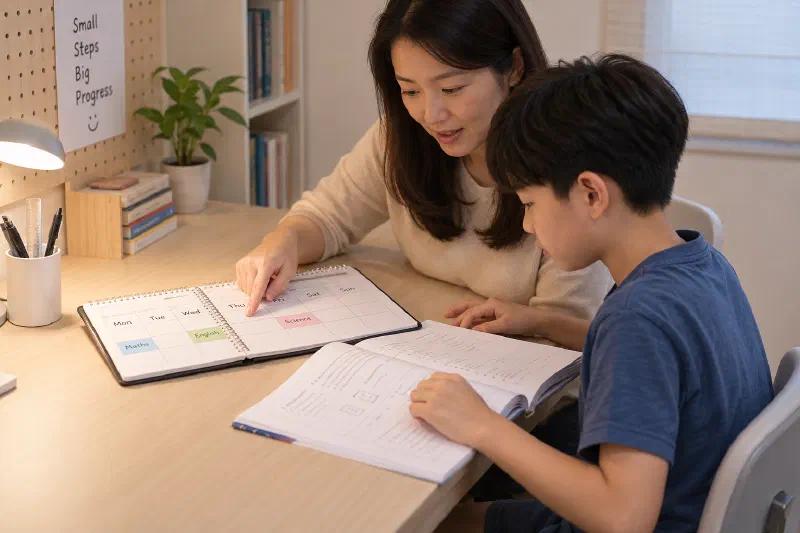
Mother pointing to a planner as her son opens a workbook.
Help should make the child more able to continue
Parents often become deeply involved in exam preparation because important work might otherwise be missed.
They identify priorities, create the timetable, gather materials, remind the child to begin and check whether each task was completed. This can keep preparation moving in the short term.
It can also leave the parent carrying almost the entire process.
Useful support should solve problems the child cannot yet manage while giving them experience with the parts they are ready to handle. The aim is not immediate independence, but preparation that does not depend indefinitely on the parent making every decision.
Some structure genuinely needs adult support
A child may not have a clear view of the full assessment period.
Parents can help connect school dates, tuition, family commitments and the amount of work that is realistically available. They may also notice patterns across results that the child sees only as separate marks.
This broader perspective is useful when deciding the initial boundaries of a plan.
A parent might establish which days are available, limit the workload to something sustainable and help identify the few priorities that matter most. They can also make sure necessary materials are accessible rather than expecting the child to organise an unfamiliar system alone.
Providing this structure is different from prescribing every action within it.
Take over less where the child can make a real decision
Children need opportunities to practise judgement, not merely follow instructions.
Within a parent-defined structure, the child might choose which of two subjects to begin with, identify the question that needs correction or decide when to complete a short task before a stated deadline.
The choice should be genuine but manageable.
Asking a child to design an entire examination plan without experience may produce confusion rather than independence. Asking them to select one useful task from clear options allows them to connect evidence with action.
When that becomes reliable, the decision can expand. The parent is not withdrawing support suddenly; responsibility is moving in steps.
Reminders can hide a planning problem
Repeated reminders are often treated as a motivation issue.
Sometimes the plan itself is unclear. “Revise Science” gives the child no obvious starting point. A schedule that changes daily or contains more work than can be completed also makes follow-through unlikely.
Before increasing supervision, make the task specific.
The child should know what material to use, what they are expected to do and when the task is finished. A short recall check or correction of two identified questions is easier to begin than an undefined instruction to study.
If reminders remain necessary, parents can agree on one check-in point rather than monitoring the child throughout the session. This keeps support available without turning preparation into continuous surveillance.
Do not correct the work for the child
Parental knowledge can make it tempting to intervene quickly.
If the child hesitates, the parent may explain the method, point out the error or lead them towards the answer. The task gets completed, but it becomes harder to tell what the child could do independently.
Allow an initial attempt where the child has enough understanding to begin. Afterwards, help can focus on identifying what blocked the attempt and what source or explanation is needed.
The same applies to corrections. A parent can ask the child to explain why an answer was wrong and what will change on the next attempt. Supplying the corrected answer may tidy the page without changing the child’s response to a similar question later.
Support should preserve enough difficulty for the work to remain the child’s.
Adjust help according to evidence
The right level of involvement is not determined by age alone.
A child may manage materials reliably but struggle to estimate time. Another may choose sensible priorities yet avoid checking corrections. Support should be directed at the weak part of the process rather than applied equally to everything.
Look for what happens when help is reduced slightly.
Does the child begin, make a reasonable choice and return when stuck? Or does the plan disappear because a necessary skill has not been established? The answer shows whether responsibility can remain with the child or needs a smaller step.
Mistakes in planning are also evidence. A task that takes longer than expected can become a reason to revise the next plan, not proof that the parent must resume complete control.
Make responsibility visible
It helps when both parent and child know who owns each part.
The parent might set the weekly boundaries and help interpret recent results. The child may gather the material, complete the agreed task and mark what needs further help. A later conversation can review what worked and adjust the next week.
As capability grows, more of those decisions can move to the child. What Should Your Child Manage Before Primary 6? looks at the specific responsibilities worth developing before the preparation demands become broader.
Parents should remain available where their involvement adds structure, perspective or support.
The measure of good help is not how little the parent does. It is whether the child is gradually becoming able to do more of the useful work themselves.