How Should Prelim Results Shape PSLE Revision?
27 July 2026
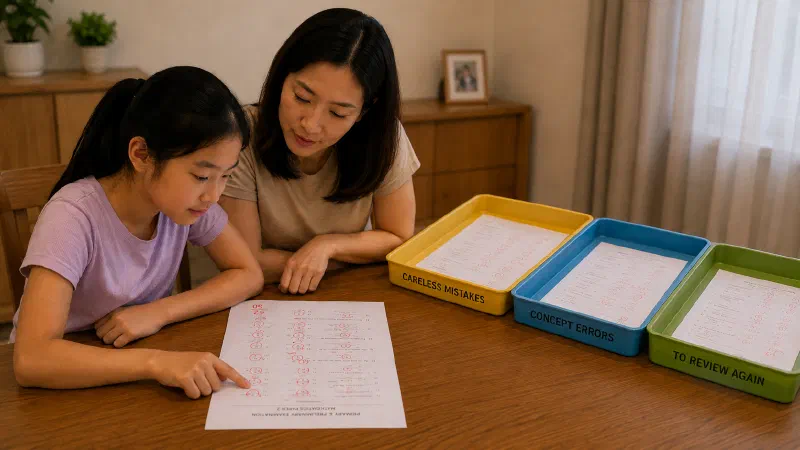
Mother and daughter examining a prelim paper beside three coloured sorting trays at a dining table.
The score is the beginning of the review, not the end
Prelim results can make the remaining PSLE preparation feel more urgent.
A lower-than-expected score may lead parents to increase revision immediately. A stronger result may create relief and the sense that the current plan should simply continue.
Neither response uses all the information the assessment can provide.
The total score shows the outcome of one paper under a particular set of conditions. It does not tell you, by itself, what your child should revise next.
For that, you need to look inside the result.
Which questions caused difficulty? Were the marks lost across many topics or concentrated in a few places? Did the child lack knowledge, apply it incorrectly, misread the question or run out of time?
Prelims become useful for planning when they help turn a general reaction into specific revision priorities.
Look for patterns rather than isolated mistakes
Every paper contains some errors that may not represent a wider problem.
A child can misread one question, forget one fact or make a calculation mistake that does not appear elsewhere.
Those errors still deserve correction, but they should not automatically reshape the remaining revision period.
Look for repetition.
Does the same concept cause difficulty across several questions? Has a similar error appeared in earlier schoolwork or practice papers? Does one component consistently perform below the rest of the subject?
A recurring pattern has more planning value than a single unusual mistake.
It suggests that the problem is likely to return unless the child does something different, which makes it a stronger candidate for focused revision.
Separate missing knowledge from performance problems
Two children can lose the same number of marks for very different reasons.
One may not understand the topic securely. The other may know the material but struggle to interpret the question, organise the answer, check the work or complete the paper in time.
Giving both children more content review would miss that difference.
For each important cluster of lost marks, ask what appears to have failed:
- Was the underlying knowledge missing or inaccurate?
- Could the child recall the knowledge but not apply it?
- Was the required answering method unclear?
- Did careless work or weak checking contribute?
- Did pacing affect the later parts of the paper?
The revision activity should match the cause.
Knowledge gaps may need explanation and recall. Application problems may need focused questions. Pacing issues may require timed sections and a clearer strategy for moving through the paper.
Do not give every lost mark equal priority
A marked paper can produce a long list of corrections.
Trying to address all of them with the same intensity can scatter the remaining revision time.
Some gaps affect several areas and deserve substantial attention. Some errors are narrow and can be repaired quickly. Others may require a large amount of time for uncertain improvement.
Priority should reflect more than the number of marks lost.
Consider:
- whether the problem is recurring
- how widely it affects the subject
- whether it can still be improved within the remaining time
- whether it is likely to matter again
- what other priorities will receive less time as a result
The aim is not to recover the prelim paper mark by mark.
It is to use the paper to improve the choices made before PSLE.
Strong results still need to be examined
A good prelim result can also hide useful information.
Perhaps the child performed well overall but lost marks repeatedly in one component. Perhaps familiar topics carried the score while an important weaker area appeared only briefly. Perhaps the result depended on a paper that happened to suit the child’s strengths.
This does not mean parents should search for problems in every success.
It means that a strong total should not end the review too early.
Identify what appears secure and can move into maintenance. Then notice any narrow pattern that still deserves attention.
The result can therefore free revision time as well as create new work. Evidence that an area is stable is a reason not to keep treating it as an equal priority.
Compare the result with other evidence
Prelims are important, but they are still one source of information.
School assignments, tuition work, earlier assessments, corrections and the child’s experience during revision can strengthen or challenge what the paper seems to show.
If one weak result conflicts with months of steady performance, look closely before rebuilding the whole plan around it.
If the paper confirms a pattern that has already appeared several times, the case for prioritising it becomes stronger.
Comparison helps protect against overreacting to one unusually good or bad day.
It also gives a clearer view of whether the issue is new, recurring or already improving.
Let your child take part in reading the result
Parents can often analyse a paper quickly and produce a list of what needs to change.
But if every weakness is identified, prioritised and scheduled by the parent, the child may remain a recipient of the plan rather than someone learning to respond to their own work.
Invite your child into the review.
Which questions felt uncertain? Where did they know they were guessing? What mistake do they recognise from earlier work? Which area do they think would improve with another attempt?
Their account will not replace the evidence in the paper, and they may miss important patterns at first.
The value lies in helping them connect a result to a next action.
Over time, recognising “this is a gap I have seen before” or “I knew the topic but did not answer the question fully” becomes part of managing revision more independently.
Turn the result into a small number of decisions
A useful prelim review should change the plan in visible ways.
That may mean giving one subject more attention, replacing broad practice with focused work, scheduling another attempt at a recurring error or moving a secure area into maintenance.
Keep the resulting priorities few enough to act on.
If the review creates a list of twenty equally urgent weaknesses, the child is left with a more detailed description of being behind rather than a clearer route forward.
The prelim result is not a prediction that must be accepted or disproved.
It is evidence about what happened, why it may have happened and where the remaining revision time can now do more useful work.