How Should Revision Change From Primary 3 to 5?
12 May 2026
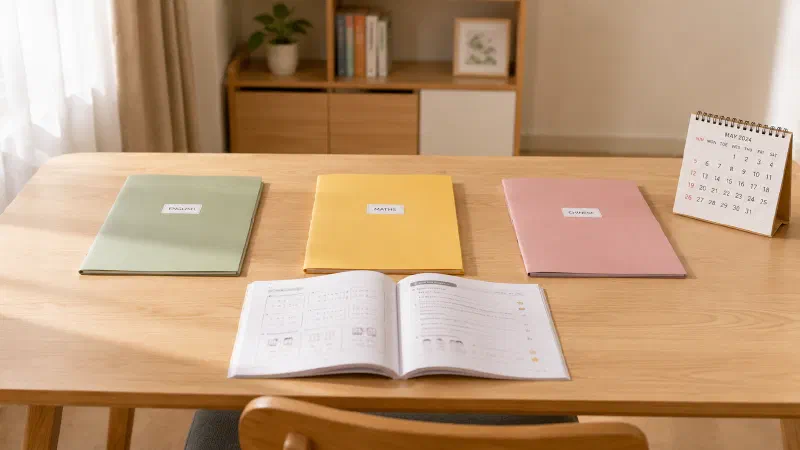
Three subject folders beside an open workbook and calendar.
Preparation should grow with the child
Parents may understand that exam preparation can begin before Primary 6 and still be unsure what that means in practice.
If the work remains too light, they may worry that valuable time is being lost. If it becomes too exam-focused, several school years can begin to resemble an extended PSLE revision period.
The answer is not to choose one fixed preparation routine and start it earlier.
Preparation should change as the child’s knowledge, school demands and ability to manage work develop. Primary 3, Primary 4 and Primary 5 are not three opportunities to repeat the same plan at increasing intensity.
Each stage has a different job.
Primary 3 should make current learning more secure
At Primary 3, the most useful preparation is often close to ordinary learning.
The child is handling new subjects, formats and expectations. Before adding broad examination practice, it is more valuable to establish what happens when something is not understood or is quickly forgotten.
This may mean returning to a difficult concept after class, correcting an exercise properly or checking whether the child can explain an idea without looking at the page.
The work does not need to be labelled as PSLE preparation. Its value lies in preventing current gaps from becoming part of the foundation for later topics.
Parents may still organise much of the process at this stage. The child can nevertheless begin contributing small observations: which question felt confusing, which correction has not been completed or which topic needs another explanation.
The aim is secure learning and a useful response to difficulty, not early familiarity with the final examination.
Primary 4 can introduce deliberate revisiting
As more material accumulates, understanding only the current week becomes less sufficient.
Primary 4 is a useful stage for the child to experience returning to earlier work after a gap. A Science concept from a previous term, vocabulary that is no longer fresh or a Mathematics method that has not appeared recently can be checked again.
This revisiting should be selective. It does not require repeating every worksheet or creating a dense revision timetable.
The child is learning that completed work can still need attention later. They can also begin using simple study methods more deliberately: attempting recall before rereading, grouping similar errors or trying a corrected question again without the worked answer beside it.
Parents may continue to decide the broad structure while allowing the child to manage one part, such as choosing which earlier topic to check or identifying what remained difficult after the attempt.
Preparation is becoming more intentional, but it is still supporting the current curriculum rather than competing with it.
Primary 5 should connect knowledge across a wider period
By Primary 5, the child has more prior material to retain and more evidence about how they respond to assessments.
Preparation can become broader. Earlier topics may be revisited alongside current work. Results can be used to identify recurring weaknesses rather than treated as isolated outcomes. The child can practise selecting a method when the topic is not announced in advance.
Planning can also become clearer.
Instead of waiting for a parent to assign every task, the child may help decide which subject requires attention, gather the relevant material and follow through on a short plan. The parent still provides boundaries and notices what the child cannot yet manage reliably.
This is also the stage at which some exam-style work may become useful. Its purpose should be defined. A broader set of questions can check whether learning transfers across topics; it should not become a routine of completing full papers simply because Primary 6 is approaching.
Do not measure progress only by workload
Increasing preparation does not have to mean adding more hours each year.
The more meaningful progression is in what the child can do with the time.
A younger child may need help noticing a mistake and completing the correction. Later, the child may be able to identify the pattern, choose an appropriate practice task and return to it after an interval.
The visible workload might not change greatly, but the thinking becomes more independent and the review becomes more purposeful.
This avoids a common problem: increasing the volume before improving the process. More work completed through the same weak habits gives the child a larger workload without creating a stronger preparation system.
Full-paper practice should not define the stages
Practice papers are easy to use as a marker of seriousness. A family may feel that preparation has advanced once the child begins completing them regularly.
But a paper is only useful when its combined demands match the child’s current needs.
Does Starting Early Mean More Practice Papers? explains why earlier preparation often benefits more from recall, correction and targeted questions before full-paper practice becomes appropriate.
The progression from Primary 3 to Primary 5 should therefore be visible in the child’s knowledge, methods and responsibility—not merely in the format or quantity of the work.
Add structure when it solves a current problem
There is no need for every child to reach the same preparation milestone in the same term.
Use the current difficulty to decide what should develop next. If learning fades quickly, introduce planned revisiting. If corrections do not influence later work, strengthen error review. If the child waits for every instruction, transfer one manageable planning decision.
By Primary 5, preparation can look more deliberate than it did in Primary 3 while still leaving room for school, rest and interests outside examinations.
The point of the earlier years is not to bring Primary 6 forward.
It is to make the child better equipped when Primary 6 arrives.