How Should Your Child Use Spaced Revision?
15 May 2026
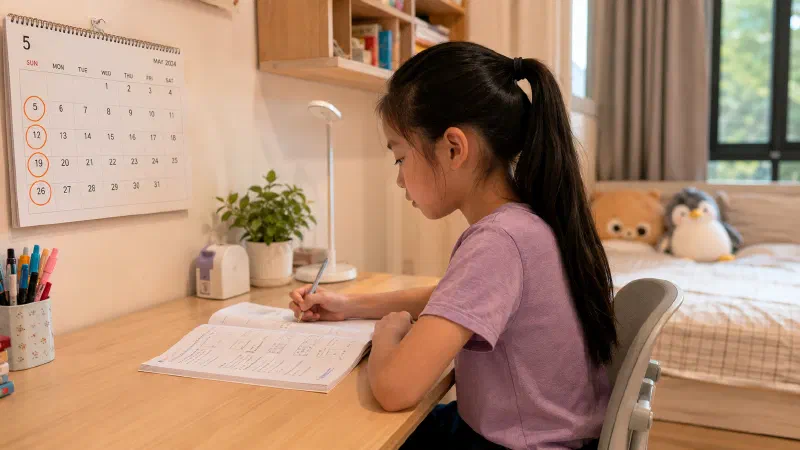
Girl reviewing a workbook beneath a wall calendar.
Learning once is not the same as retaining it
A child understands a topic, completes the assigned work and performs well on a short assessment.
Several months later, much of it is difficult to recall.
This does not necessarily mean that the original learning failed. Knowledge becomes less accessible when it is not used, and material that felt secure while it was current may need support to remain available across the school year.
Spaced revision provides that support by returning to learning after a gap.
The purpose is not to revise everything continuously. It is to revisit selected material before it has to be learned almost from the beginning again.
The gap is part of the method
Repeating the same material several times in one sitting may make the final attempt feel easy. The answer is still familiar, and the child has had little opportunity to forget it.
Spaced revision allows some time to pass.
The child then has to bring the learning back when it is no longer immediately available. That effort gives a more useful indication of whether the material can be retained and retrieved later.
Suppose a child revises a set of Science concepts on Monday and answers the questions accurately. Completing the same questions again immediately may add little. Returning after other schoolwork has intervened asks something different: can the child still explain the ideas without relying on the recent session?
The interval makes the revisit informative.
Revisit what needs to last
Spacing does not mean placing every topic into a permanent cycle.
Some material is used often enough in current lessons that it is already being revisited. Some is secure and only needs an occasional check. Other knowledge fades quickly or supports later topics, making it more useful to return to.
Recent work can help identify candidates:
- a concept the child understood but soon forgot
- vocabulary that is recognised but difficult to produce
- a method that works in familiar exercises but disappears in mixed questions
- a corrected error that returned in a later assessment
This keeps spaced revision selective. The child is not repeating the entire syllabus at fixed intervals; the plan is protecting learning that is likely to be needed again.
Start with an attempt, then use the source
A revisit should show what the child can still access.
If the notes remain open throughout, the child may recognise the material without retrieving it. Begin with a short attempt: explain the idea, answer a question or reconstruct the method before looking.
The source can then be used to check the response.
Missing or confused parts receive attention. Material that remains secure can be left for a later check. If the child discovers a deeper misunderstanding, the session should shift from recall to explanation rather than repeatedly testing something that was never clear.
This attempt-check-correct sequence makes the revisit responsive. The result determines what happens next.
The spacing should respond to the child
There is no single interval that works for every subject or learner.
A difficult item may need another attempt while the correction is still relatively recent. Secure material can wait longer. As recall improves, the gap can widen; if the child repeatedly forgets the same part, the explanation or practice method may need to change.
School life also affects the schedule. New topics, homework and assessment periods mean that revisits cannot always happen on an ideal timetable.
The important feature is not mathematical precision. It is that earlier learning returns after genuine gaps instead of disappearing until the next examination.
Keep spaced revision small enough to sustain
A system becomes difficult to maintain when every completed topic creates several future tasks.
Short checks are often enough. A few questions, a brief explanation or one mixed exercise can show whether learning remains accessible.
If the child remembers the material well, the session can end. If not, the plan has found a useful next step.
This is different from filling each week with repeated full lessons. Spaced revision should reduce later relearning, not create a second curriculum alongside the first.
Use natural points in the year
Transitions between terms, quieter weekends and school holidays can provide opportunities to bring earlier material back.
These periods should not become attempts to revisit everything that has been taught. Choose a limited purpose based on what is most likely to fade or what the child will need in the next stage.
How Can School Holidays Support Exam Revision? considers how one of those longer breaks can support consolidation without turning the entire holiday into an examination schedule.
Spaced revision works when the child repeatedly meets important learning after enough time has passed for recall to require effort.
The goal is not constant revision. It is less need to start again.