Should Parents Plan the Entire PSLE Revision Schedule?
26 June 2026
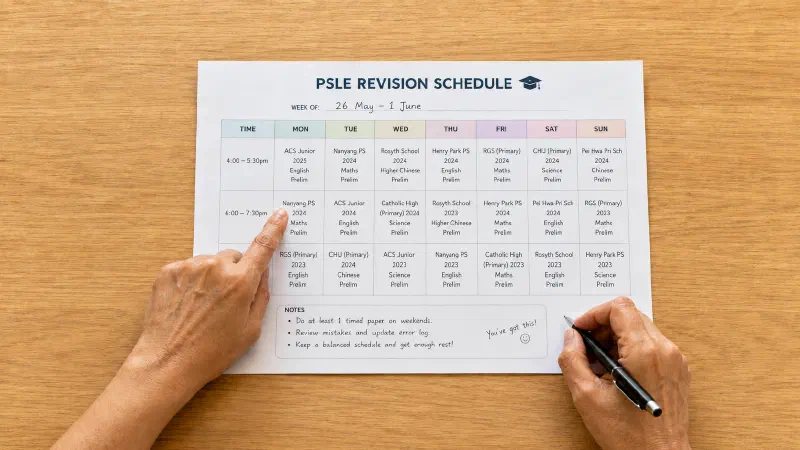
Parent planning PSLE schedule for her child.
Planning the schedule and managing the revision are not the same thing
For many Primary 6 parents, creating a PSLE revision schedule feels like the sensible thing to do.
There are several subjects to cover, limited weeks remaining, schoolwork still happening, and often tuition or other commitments already occupying parts of the week.
Without some structure, it is easy for revision to become reactive.
The question is not really whether parents should be involved in planning.
It is how much of the planning and management should continue to sit with the parent once the schedule exists.
A parent may help create a perfectly sensible revision plan. That does not necessarily mean the parent also needs to decide what happens every afternoon, remind the child before every session, check every completed task and reorganise the week whenever something slips.
Those are different jobs.
Parents can see the bigger picture more easily
There are good reasons for parents to be involved, especially at the beginning.
A parent may have a clearer view of:
- how many weeks remain
- which days are already occupied
- when school assessments or prelims take place
- which subjects currently need more attention
- how much work can realistically fit into a week
A child may be thinking mainly about what is due tomorrow.
The parent is often better placed to see the entire preparation period.
That makes parental involvement useful when the revision plan needs an overall structure.
For example, if Science needs more attention but three evenings are already occupied by tuition, simply telling the child to “revise more Science” does not solve much.
Someone still has to work out where that revision fits.
Too much detail can make the schedule harder to use
A schedule can also become so detailed that maintaining it becomes a task of its own.
A parent might assign:
Monday
4.00–4.45pm: Science electricity
4.45–5.00pm: corrections
5.00–5.30pm: English vocabulary
and continue doing the same for every available period across several weeks.
That creates certainty, but it also creates fragility.
If Monday’s Science session takes longer than expected, Tuesday’s plan may already need changing.
If school gives additional homework, the schedule needs changing again.
If a topic turns out to require less revision than expected, the original allocation may no longer make sense.
The more tightly every hour is prescribed, the more often someone has to maintain the plan.
A useful schedule should provide enough structure to guide revision without requiring constant administration.
Plan the priorities before planning every task
One way to avoid over-planning is to separate the important decisions from the small decisions.
The important decisions might include:
- which subjects need more attention
- what major areas still need to be covered
- how many revision sessions are realistically available
- what should be completed before particular milestones
- where lighter periods are needed
Those decisions shape the overall revision plan.
Smaller decisions can often remain flexible.
For example, instead of deciding three weeks in advance exactly which Science worksheet must be completed on a particular Tuesday, the schedule might simply reserve that session for Science revision.
The exact task can then depend on what the child most needs at that point.
This gives the plan structure without pretending that every future revision need can be predicted today.
Let the schedule show direction, not control every movement
A good revision plan should make it easier to answer:
What matters this week?
It does not necessarily need to answer:
What must happen at every minute of every day?
The first creates direction.
The second can turn revision into a sequence of instructions that someone else has to keep issuing.
For many families, a middle ground is more workable.
The parent helps establish the overall plan. The child can then have increasing responsibility for decisions within that structure.
That might mean choosing:
- which task to complete first
- when within an available block to start
- which correction needs another attempt
- whether a planned task has genuinely been completed
- what needs to move when a session is missed
The amount of responsibility can vary by child.
The important point is that parental involvement does not have to be all or nothing.
Use the schedule to reduce planning work
If the difficult part is turning the remaining weeks into a workable structure, the PSLE Revision Planner can help organise the revision period without requiring parents to manually build the entire schedule from scratch.
A tool is most useful here when it removes the administrative work of planning.
It should not create another system that the parent then has to supervise constantly.
Once the structure exists, the more important question becomes how the child interacts with it.
Pay attention to who keeps the plan alive
Two children can appear to be following the same revision schedule while doing something quite different underneath.
In one household, the child checks the schedule, starts the planned work and notices when something needs to change.
In another, the schedule only works because the parent repeatedly says:
“It’s time to start.”
“You still haven’t done Science.”
“Remember to mark your paper.”
“We need to move this to tomorrow.”
Both children may ultimately complete the same amount of revision.
But the responsibility for making that revision happen sits in a different place.
That distinction is worth noticing.
There is nothing inherently wrong with a Primary 6 child needing support. A revision schedule is a practical tool, not a test of independence.
But if the parent has to keep initiating, monitoring and adjusting every part of the process, the deeper issue is no longer just whether the schedule has been designed well.
It becomes a question of who currently owns the work of managing it.
The best schedule should gradually need less management
Parental involvement can be particularly valuable when the revision period first needs structure.
But the schedule should ideally make the next step clearer for the child, not create a new set of instructions that only the parent knows how to operate.
That may mean starting with more involvement and gradually stepping back from smaller decisions as the child becomes more familiar with the plan.
The goal is not to remove support for the sake of independence.
It is to make sure the support is helping the child use the structure, rather than making the structure dependent on the parent.
A revision plan can organise the work.
Over time, the more interesting question is whether the child is also learning to organise themselves within it.