What If Your Child Keeps Falling Behind on PSLE Revision?
10 July 2026
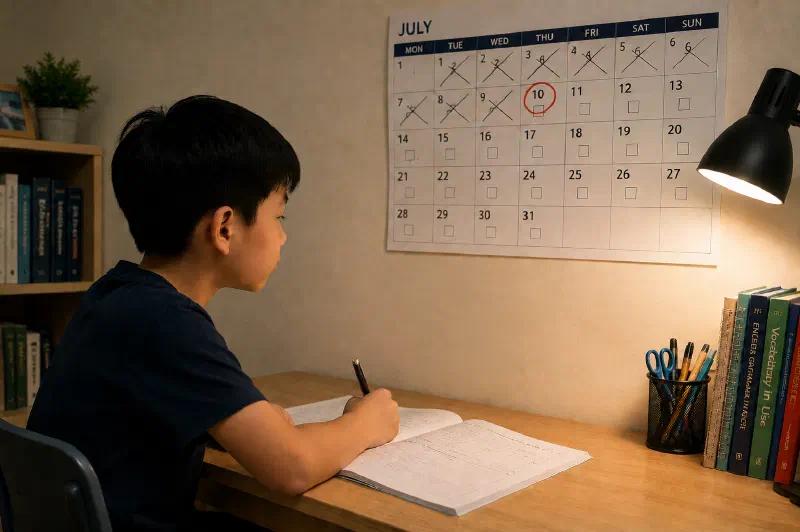
Side view of a boy at a desk beneath a calendar with blank task cards pinned to earlier dates.
Falling behind is information about the plan
An unfinished revision task is not unusual.
Homework takes longer than expected. Tuition adds an assignment. A child has a tiring day and completes less than planned.
The problem is when unfinished work becomes the normal pattern.
Monday’s task moves to Tuesday. Tuesday’s work is added to Wednesday. By the weekend, the schedule contains both the current plan and several days of backlog.
At that point, telling the child to catch up may not address what is actually happening.
Repeated slippage is useful information. It suggests either that the plan asks for more than the available time can support, or that the child is having difficulty acting on a plan that should otherwise be workable.
Those are different problems, and they need different responses.
First check whether the workload ever fitted
A schedule can look reasonable when revision is considered on its own.
The same schedule may become impossible once school, homework, tuition, meals and rest are put back into the week.
Look at the work that repeatedly spills over.
Does a practice paper take longer than the slot given to it? Is marking and correction missing from the estimate? Are several demanding tasks placed on evenings that are already full? Does the weekend depend on the child working steadily for far longer than they normally can?
If the answer is yes, the child may not be falling behind because of poor discipline.
The schedule may have been ahead of reality from the beginning.
Reducing or redistributing the workload is not lowering expectations. It is making the plan honest enough to be used.
Poor estimation can quietly create a backlog
Sometimes the total amount of work is reasonable, but individual tasks are too vague to estimate properly.
“Revise Science” might mean reviewing notes, recalling key ideas, answering questions and correcting mistakes. A task described as one item can contain an entire session’s worth of smaller activities.
Practice papers create a similar problem.
The time needed is not only the length of the paper. There is also marking, understanding errors and retrying questions that were not done well.
When these parts are omitted, every task appears shorter on the schedule than it is in practice.
Make the work concrete enough to estimate:
- which topic or component is involved
- what material will be used
- whether correction is included
- what counts as completed
A clearer task makes it easier to tell whether the plan is unrealistic or whether something else is getting in the way.
A workable plan can still be difficult to begin
Suppose the workload fits the week and the tasks are reasonably clear, but your child still does not start without repeated reminders.
This points to a different difficulty.
The problem may lie in moving from intention to action. The child can understand the schedule, agree that it is manageable and still struggle to begin when the time comes.
Making the plan smaller will not always solve that by itself.
It may help to reduce the immediate decision. Instead of “complete today’s revision”, the starting point could be to open the correction book and retry the first two questions marked for review.
Once the child begins, the rest of the session may become easier to enter.
The aim is not to supervise every movement. It is to notice where the process repeatedly stops.
Do not make tomorrow carry everything missed today
The instinct after an unfinished day is often to move all the work forward.
That protects every task on paper, but it can make the next day even less achievable.
A better response is to decide what the missed work now means.
Some tasks are still important and should move. Some can become shorter. Some may be replaced by a more urgent priority. Others may no longer justify taking time away from the current plan.
This requires judgement, but that is the point.
A revision schedule should help the family make choices. It should not turn every incomplete task into a debt that must be repaid regardless of what happens next.
If backlog is allowed to grow automatically, the child may start each session already feeling behind.
Look for the pattern behind the pattern
The same type of slippage can reveal where the difficulty sits.
If work is usually completed on lighter days but not after tuition, the schedule may be ignoring energy and commitments.
If familiar tasks are completed but difficult subjects are repeatedly postponed, the child may be avoiding work that feels uncertain.
If revision begins only after several reminders, the challenge may be initiation rather than workload.
If tasks are started but rarely finished, the plan may need clearer stopping points or shorter units of work.
Instead of responding to each missed task separately, look for what keeps recurring.
The repeated pattern often tells you more than the size of the current backlog.
Notice who is keeping the schedule alive
A plan can appear to be working while most of its management sits with the parent.
The parent remembers what is due, announces when revision should begin, checks whether it happened and decides how missed work should move.
That support may be necessary for now. A Primary 6 child does not need to manage the entire preparation period alone.
But it is useful to see the arrangement clearly.
Can your child identify today’s task without being told? Do they notice when something remains unfinished? Can they suggest what should move, shorten or change? Are they beginning to recognise which areas need more attention?
These are small forms of ownership.
The goal is not to withdraw support suddenly. It is to use the schedule to make the work increasingly visible and manageable to the child, rather than building a system that functions only while a parent operates it.
Redesign the part that is actually failing
When a child keeps falling behind, more reminders and a stricter catch-up plan can feel like the obvious response.
They may also add pressure without fixing the cause.
If the workload is too large, reduce or redistribute it. If tasks are poorly defined, make them clearer. If the child struggles to begin, make the starting point easier to act on. If the schedule depends entirely on parental management, gradually give the child responsibility for one visible part of it.
The aim is not to preserve the original plan.
It is to create a plan that can survive contact with the actual week and that your child can increasingly learn to use.