What Should a Good PSLE Revision Week Actually Include?
13 July 2026
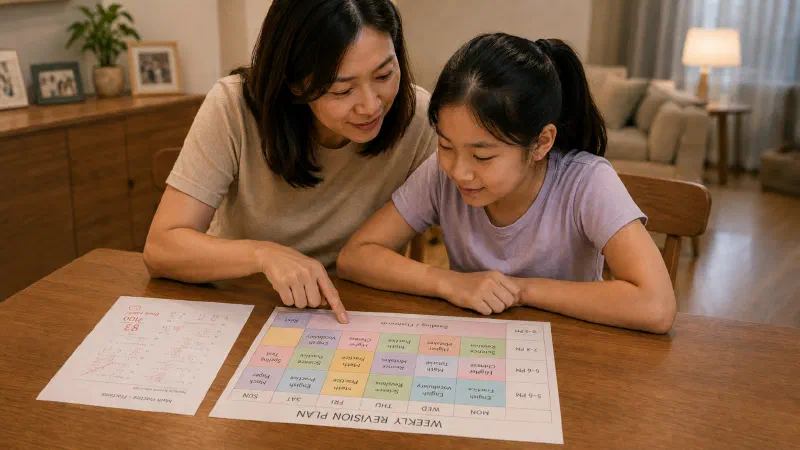
Mother and daughter reviewing a colour-blocked weekly planner and corrected worksheet at a dining table.
A full week can still be an incomplete revision week
A revision schedule may contain plenty of work and still leave important parts of learning out.
There might be several worksheets, two practice papers and a list of chapters to read. Every available session has something assigned to it.
The week looks productive because there is a lot to complete.
But completion is only one part of revision.
If your child answers questions without returning to mistakes, reads notes without trying to recall the ideas, or moves from one paper to the next without revisiting weak areas, the schedule may produce activity without enough learning.
A good PSLE revision week should contain different kinds of work because each kind serves a different purpose.
The aim is not to fill the timetable. It is to create a useful cycle between remembering, applying, correcting and returning.
Recall shows what is available without the notes
Reading can make material feel familiar.
That familiarity is not always the same as being able to retrieve the information when it is needed.
Recall work asks the child to bring something to mind before looking at the answer. That might mean explaining a Science process, writing down a formula, testing vocabulary, outlining the steps in a method or answering a question without referring to notes.
This has a different purpose from reviewing the material.
It reveals what the child can currently produce independently.
When recall is difficult, the answer is not necessarily to spend the entire session testing. The result helps identify what needs to be reviewed and tried again.
Without some recall, a child can spend a week looking at familiar material without discovering how much of it is actually accessible.
Practice should answer a specific question
Practice matters, but it is more useful when there is a reason for choosing it.
A topical worksheet may help check whether a recently reviewed concept can be applied. A timed section may reveal whether the child can work accurately under a constraint. A full paper may help with endurance, pacing and the combination of different question types.
These are not interchangeable.
If a child is struggling with one Mathematics question type, another full paper may be a slow way to encounter that weakness again. Focused practice could provide a clearer view.
If the concern is completing an entire paper within the available time, isolated topical questions will not test the same thing.
Before placing practice into the week, ask:
What are we trying to find out or improve through this piece of work?
The answer helps determine whether the task belongs in the plan.
Corrections are part of the task, not an extra
Practice creates useful information only when mistakes are examined.
A paper marked and put away tells the child the score. It does not necessarily change what will happen the next time a similar question appears.
Correction should go beyond copying the right answer.
The child may need to identify whether the mistake came from missing knowledge, misunderstanding the question, choosing the wrong method, skipping a step or working carelessly. Different causes call for different responses.
Some errors need a brief correction. Others need the topic to be reviewed before the question is attempted again.
This takes time.
If a schedule assigns one hour to a one-hour paper and immediately moves on, the correction work has effectively been left out. A realistic revision week accounts for what happens after the answers are checked.
Review repairs what practice has exposed
Practice identifies a gap. Review helps address it.
That review should be connected to the problem rather than becoming a broad return to everything in the chapter.
If several Science questions reveal confusion between two related concepts, the child can compare those ideas directly. If an English comprehension response repeatedly lacks enough support from the passage, the review can focus on how evidence is selected and used.
The aim is to repair something specific.
This is why a useful week needs room between pieces of practice. The next task should sometimes respond to what the previous task revealed.
A schedule made entirely in advance at a very detailed level can struggle here. It may leave no space for the plan to learn from the child’s work.
Revisiting checks whether the change lasted
Correcting a mistake once can create a strong feeling of understanding.
The child has just seen the explanation. The right method is clear. The corrected answer now makes sense.
The more useful test comes later.
Can the child answer a similar question after several days? Can they recall the idea without the correction beside them? Does the same error return in a different context?
Revisiting gives the week a connection to earlier weeks.
It might involve retrying selected questions, completing a short recall check or returning to a previously weak topic. It does not require repeating every piece of work.
The purpose is to make sure the plan is not constantly moving forward while earlier gains quietly disappear.
Not every activity needs equal time
A useful mix does not mean dividing the week evenly among recall, practice, correction, review and revisiting.
The balance should reflect what your child currently needs.
A child with several knowledge gaps may need more review and focused recall. A child who understands the material but struggles to apply it may need more practice followed by careful correction. Nearer the examination, the week may contain more consolidation and fewer attempts to open large new areas.
The mix can also differ by subject.
Mother Tongue vocabulary may benefit from frequent short recall. A difficult Science topic may need a longer block for explanation and application. A full Mathematics paper may require a separate correction session.
The categories help parents think about what the week contains. They are not a formula that every family must copy.
Build the week around learning, not volume
When planning the week, it can help to check whether each priority has a complete enough path:
- What needs to be recalled or reviewed?
- Where will the child practise it?
- When will mistakes be examined?
- What needs to be revisited later?
Not every topic needs all four steps in the same week. The questions simply reveal whether the schedule repeatedly stops at task completion.
The PSLE Revision Planner can help turn subject priorities and available time into an actual schedule. When using it, leave enough room for the work that practice creates, especially corrections and targeted review.
A strong revision week is not the one with the longest list of completed pages.
It is the one in which each activity gives the next activity better information about what the child should do.