What Should Your Child Manage Before Primary 6?
05 June 2026
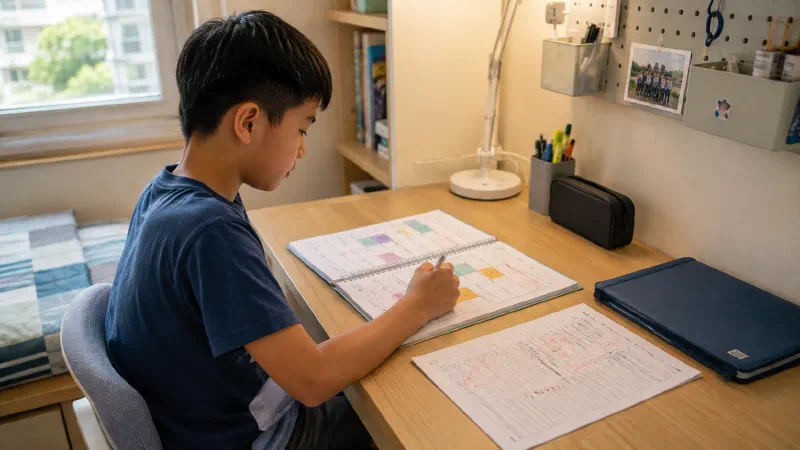
Boy updating a weekly planner beside a corrected worksheet.
Primary 6 should not be the first time a child manages preparation
The workload becomes broader in Primary 6, but the organisational demands can be just as challenging.
A child may need to keep track of corrections, locate earlier material, decide what requires attention and follow a plan across several subjects. If every part has previously been handled by an adult, these responsibilities arrive at the same time as more demanding academic work.
Children do not need to manage the entire process before Primary 6.
They should have repeated experience with a few concrete parts of it. The aim is not complete independence. It is enough familiarity that preparation does not stop whenever a parent is not directing the next action.
Start with materials that can actually be found
A revision task cannot begin if the child spends the session searching for the relevant paper.
Parents often solve this by gathering everything in advance. That keeps the immediate plan moving, but it gives the child little reason to develop a system they understand.
Begin with one manageable responsibility. The child might keep marked work for each subject in a consistent folder or return incomplete corrections to one agreed place.
The system should be simple enough to use during an ordinary school week. A complicated filing method maintained mainly by the parent may look organised while remaining inaccessible to the child.
The useful test is practical: when a particular correction or topic is needed, can the child locate it without the parent reconstructing the system?
Corrections need an owner
Marked work easily becomes a parent-managed queue.
The parent notices the red marks, reminds the child to correct them and later checks whether the task was completed. The child experiences the correction as another instruction rather than a response to evidence in their own work.
Before Primary 6, the child can begin taking responsibility for recognising what remains unfinished.
This may involve marking a paper for follow-up, completing the correction and identifying any part that still needs explanation. The parent can check at an agreed point instead of monitoring every step.
Ownership does not mean that the child must understand every error alone. It means they know that a marked mistake requires a next action and can begin that process.
The child should recognise a useful priority
Choosing what to revise is difficult when every subject contains possible work.
Children can begin with limited decisions. Given two marked exercises, which one shows a repeated problem? After a recall check, which topic was least secure? Among several corrections, which one blocks the next piece of work?
These questions teach the child to connect evidence with priority.
The parent may still set the wider boundaries, especially when assessment dates and competing commitments need to be considered. Within those boundaries, the child can explain why one task should come before another.
The explanation matters more than always choosing perfectly. A weak choice can be reviewed and improved; a choice made entirely by the parent gives the child no practice in judgement.
Short plans teach follow-through
Managing a plan is different from helping to create one.
A child may agree that a task matters and still underestimate how long it will take, forget the material or stop after the first difficulty. These are planning skills that improve through use.
Start with a short period and a limited number of clearly defined tasks. The child should know what completion looks like and when the plan will be reviewed.
The PSLE Revision Planner can provide the overall structure while allowing the child to participate in choosing priorities and placing manageable tasks into the available time.
If the plan does not work, examine why. The task may have been too broad, the timing unrealistic or the starting point unclear. Revising the plan teaches more than simply replacing it with an adult-made version.
Asking for help is part of managing the work
Independence is sometimes confused with completing everything alone.
A child who remains stuck for a long period because they do not know when to ask for help is not managing the task effectively. Neither is a child who asks immediately whenever effort is required.
Agree on what the child should try first and what should trigger support. They might reread the question, consult one example or identify the exact step that is confusing before approaching an adult.
This makes help more focused. It also gives the child a process for responding when the first attempt does not work.
Transfer one responsibility at a time
Responsibility should move according to what the child can handle reliably.
One child may organise materials well but need help choosing priorities. Another may plan sensibly but avoid corrections. There is no benefit in transferring the whole process simply because Primary 6 is approaching.
How Should Revision Change From Primary 3 to 5? shows how knowledge, study methods and responsibility can become more structured across the earlier years.
Before Primary 6, look for the next part the child can genuinely own.
The goal is not a child who never needs support. It is a child who can recognise the next useful action, carry out more of it and seek help with greater clarity when needed.