When Should Your Child Start Practice Papers?
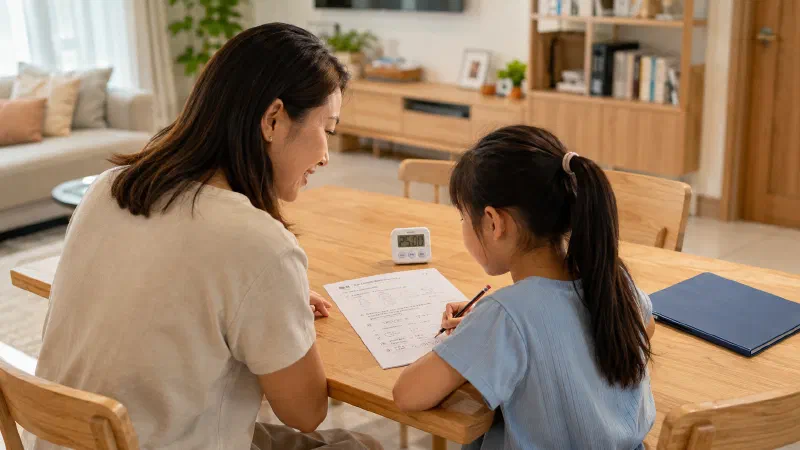
Mother and daughter reviewing a practice paper beside a timer.
Practice papers are useful when the complete task matters
Families often ask when a child should begin practice papers as though there is one correct point on the calendar.
Starting sooner can appear to provide more preparation. Waiting can feel risky because the child has less time to become familiar with the format.
The better starting point is not a date alone.
Practice papers should enter the plan when the child is ready to benefit from the demands that a complete paper brings together: recalling learning across topics, choosing methods without prompts, sustaining attention and eventually managing time.
Before those demands are useful, narrower work may prepare the child more directly.
Secure enough knowledge to make the attempt meaningful
A paper samples material from across a subject.
If large parts have not been taught or understood, a low result provides little new information. The child may simply encounter questions they were not yet equipped to answer.
This does not mean every topic must be perfect before any paper is attempted. It means the child should have enough relevant foundation for the attempt to reveal something beyond missing exposure.
Where knowledge remains weak, explanation, recall and focused questions may be the better starting point. A paper can be introduced later to check whether those parts remain available when mixed with other material.
The format should not arrive before the learning it is meant to test.
Use papers to practise selection and transfer
Topic-based exercises tell the child what kind of thinking is required.
A full paper removes some of that guidance. The child must recognise which knowledge applies, choose an approach and move between different demands.
This makes papers useful when individual skills appear secure but need to be applied in a less predictable setting.
For example, a child may solve a Mathematics method accurately in a focused exercise yet fail to recognise it in a mixed paper. The problem is no longer simply performing the method. It is selecting it from among other possibilities.
A paper can expose that gap and provide practice with the broader decision.
Timing should be introduced for a reason
A practice paper does not have to be timed from the first attempt.
If the initial purpose is to understand the format or see how the child handles mixed questions, strict timing may add pressure without producing useful evidence. The child can first attempt the paper with enough time to show what they know.
Timing becomes relevant when pace is part of the question.
Does the child spend too long on one section? Does accuracy fall near the end? Can they make a reasonable decision when a question is difficult?
Once those are the skills being practised, more realistic time boundaries make sense. Exam conditions should be added because they create the demand the child now needs to manage, not because every paper must simulate the final day.
The review determines whether the paper was worthwhile
Completing a paper produces a score and a set of answers. Preparation improves through what happens next.
Review the errors by cause. Some may show forgotten knowledge. Others may reveal a recurring misconception, weak question interpretation or a pacing decision that affected later sections.
The next task should respond to that evidence.
This may mean leaving full papers temporarily and returning to a smaller piece of work. The child can relearn a concept, compare examples or practise one question type before checking it again in a later mixed setting.
Another paper is useful when it tests whether those changes transfer. It is less useful when it merely repeats the same broad diagnosis.
Frequency should follow the purpose
Once papers enter the plan, they do not need to dominate every session.
A paper takes time to complete and more time to review properly. If the schedule allows only completion, unresolved errors accumulate while new scores continue to arrive.
Alternate broad attempts with the focused work they produce. A paper may identify one or two priorities; the following sessions address them; a later paper checks what changed.
This creates a preparation cycle rather than a paper-completion target.
As the examination moves closer, broader practice may become more frequent because familiarity, pacing and sustained performance become more relevant. Even then, the evidence from each attempt should continue to shape the work between papers.
Move into PSLE revision deliberately
Practice papers become appropriate when they answer a question that smaller tasks cannot answer well.
Can the child select and apply learning across topics? Can they maintain accuracy over a longer task? Do earlier corrections appear in a less-supported setting? Can they manage the format and available time?
When those questions matter, a paper has a clear place in preparation.
The next step is deciding how paper practice fits among subject priorities and other revision demands. How Should You Divide PSLE Revision Across Subjects? explains how to allocate attention once the more structured PSLE revision period begins.
Do not use practice papers merely to prove that preparation has become serious.
Use them when the child is ready to learn from the complete task.