Which Revision Methods Should Your Child Use?
26 May 2026
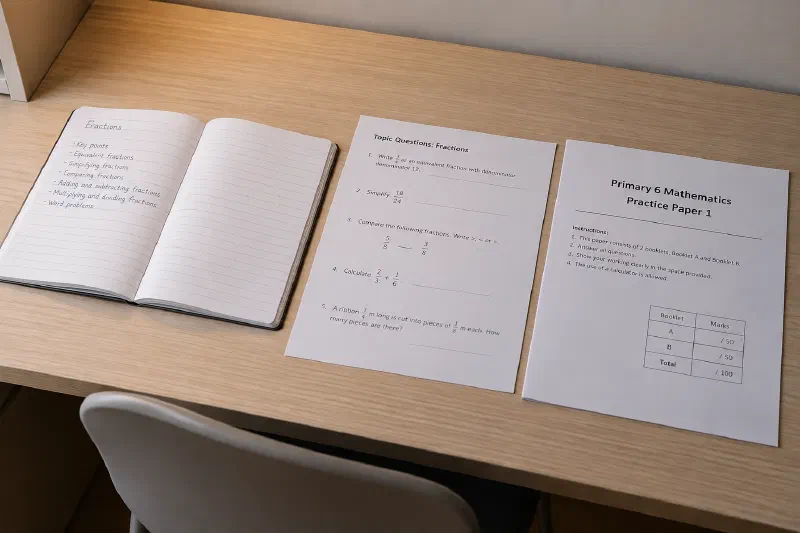
Notes, practice questions and a full paper on a study desk.
The most familiar revision method is not always the useful one
Children often settle into one form of revision.
Some repeatedly read or rewrite notes. Others complete question after question. As examinations approach, families may rely heavily on practice papers because they appear closest to the final task.
Each method can help. None of them performs every job.
The right choice depends on what the child is trying to strengthen at that point in preparation.
Notes help when understanding needs support
Notes are useful when the child needs to organise, clarify or revisit an explanation.
A concise diagram may show how ideas connect. A worked example can make the steps in a method visible. A summary can help the child locate the part that was forgotten.
The limitation appears when looking at the notes becomes the whole revision session.
Information can feel familiar while it remains difficult to recall without the page. Copying a summary may produce a neat record without showing whether the child understands or can use it.
After the notes have served their explanatory purpose, remove them briefly. Ask the child to explain the idea, reconstruct the method or answer a relevant question. This reveals whether the support has become usable knowledge.
Short questions reveal what is available
Questions can focus attention more precisely than a full paper.
They can check recall, isolate one method or give the child several attempts at a recurring weakness. Because the task is narrow, the response can also be narrow.
If a child cannot answer a recall question, they may need to revisit the source. If the knowledge is present but the application fails, comparing the attempt with a worked example may be more useful. If a corrected mistake returns, another related question can test whether the change held.
How Does Retrieval Practice Help With Revision? explains why attempting a question before looking at the answer provides different information from rereading alone.
Questions work best when they are selected for a reason rather than completed simply to increase volume.
Targeted practice strengthens application
Knowing a fact or method does not guarantee that the child will recognise when to use it.
A small set of related questions allows the child to practise applying the same idea in different forms. Early attempts may include more guidance. Later questions can remove that support or mix the target with other material.
This is particularly useful after a marked assessment identifies a specific weakness.
The child does not need to repeat the entire subject to address one pattern. Focused practice creates several opportunities to make the relevant decision, receive feedback and try again.
Once the method becomes reliable in a narrow set, mixed questions can test whether the child still selects it without being told what the exercise is about.
Practice papers bring separate demands together
A full paper becomes useful when the child needs to manage more than one topic or skill at a time.
The paper may require decisions about question order, time and when to move on. It can show whether knowledge remains accessible when topics are mixed and whether corrections from focused work transfer into a broader setting.
This is a different purpose from learning an unfamiliar concept or repairing one specific error.
When a paper exposes a problem, the next activity may need to become smaller again. The child can return to notes for clarification, use short questions to check recall or complete targeted practice before attempting another broad paper.
Effective preparation moves between formats. It does not progress in one direction from notes to questions to papers and then remain there.
Match the activity to the evidence
Before choosing the revision format, name the current problem.
If the child cannot explain the material, notes or teaching may be needed. If the page looks familiar but recall is weak, use retrieval. If the child knows the method but applies it inconsistently, use targeted questions. If individual parts are secure but performance changes across a full assessment, a paper may now provide the appropriate practice.
The result of the activity should then shape the next choice.
A successful recall check may allow the topic to wait. Repeated errors may require explanation. A well-completed targeted set may be ready to appear among mixed questions.
This keeps revision responsive rather than allowing habit to choose the format.
Use the smallest task that answers the current question
Larger tasks are not automatically more valuable.
A full paper is inefficient when the family only needs to know whether one correction lasted. Rereading an entire chapter is unnecessary when one idea remains unclear. A long set of similar questions adds little once the child can apply the method reliably.
Choose the smallest activity that can reveal or create the needed change.
Notes, questions and papers should not compete to become the single best revision method. Their value comes from being used for the job each can actually do.