Why Review Errors Before Doing More Questions?
02 June 2026
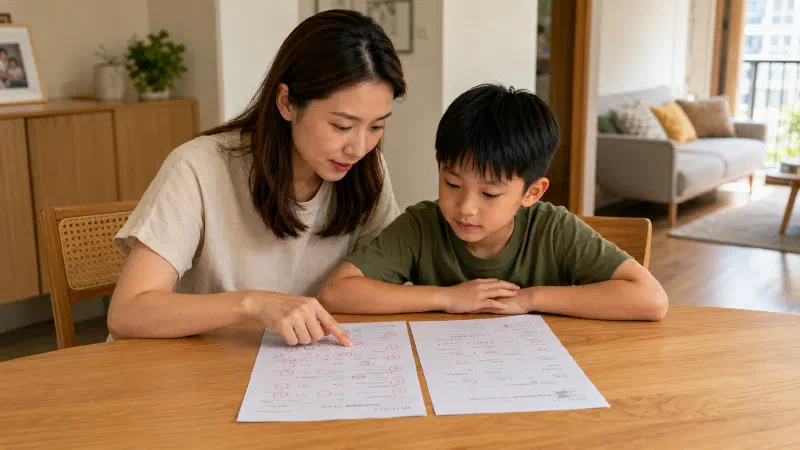
Mother and son reviewing a corrected worksheet.
Another question does not automatically change the mistake
When a child answers something incorrectly, the usual response is more practice.
If one question was wrong, several similar questions should provide another opportunity to get it right. Sometimes they do.
But repetition only helps when the child understands what needs to change.
A child who misread the first question may misread the next five. A child using an unsuitable method may practise that method more fluently. Completing additional work without examining the error can strengthen the same response that produced it.
Error review creates the link between one attempt and the next.
Begin with the cause, not the correct answer
Looking at the answer key shows what the final response should have been. It does not always explain why the child’s answer went wrong.
The cause may be missing knowledge. The child may have misunderstood the instruction, selected the wrong method, omitted an important step or made an execution error after choosing correctly.
These differences matter because they lead to different actions.
Missing knowledge needs explanation and later recall. A question that was misread may need the child to compare wording across examples. An incomplete answer may require attention to what the response must include. A careless calculation may need a checking routine at the point where the error usually occurs.
Writing the correct answer beside the mistake can complete the correction without addressing any of these causes.
Ask the child to reconstruct the attempt
The marked page shows the outcome. The child can often explain the thinking that produced it.
Ask what they thought the question required, why they chose that method or where they first became uncertain. The purpose is not to make the child defend the answer. It is to locate the decision that needs attention.
Sometimes the child cannot explain because the answer was guessed. That is useful information too. The next step may need to return to understanding rather than provide more questions of the same type.
Parents should avoid supplying an explanation before the child has had a chance to identify the problem. An adult’s account may be accurate while missing what actually happened in the child’s reasoning.
Match the correction to the error
A useful correction is more than a neat replacement answer.
If a concept was missing, the child can revisit the explanation and then try to produce it without looking. If the method was wrong, they can compare the conditions under which two methods are used. If an answer was incomplete, they can examine what the question asks for and revise the response.
The correction should make one future action clearer.
This is why error review often takes longer than checking a mark. The time is not spent on the number of questions completed; it is spent changing the process that will meet the next question.
Once that change is understood, a small amount of targeted practice can test it.
Use another attempt to check the correction
Understanding an error while looking at the marked paper does not guarantee that the child will respond differently later.
The next attempt should remove some of the support.
The child can retry the original question after a gap or complete a similar question without the correction beside it. If the same error returns, the review has revealed that the change was not yet secure.
This does not make the review pointless. It shows that the response needs another step—perhaps clearer explanation, a more focused comparison or another delayed attempt.
When the child succeeds, the family has evidence that the correction affected later work rather than only improving the appearance of the original page.
Look for errors that repeat across work
One mistake may be unusual. A repeated pattern deserves more attention.
Several marked exercises may show that the child regularly overlooks units, answers only one part of a question or confuses the same two concepts. Grouping these errors can reveal a shared cause that is hard to see when each paper is reviewed separately.
This also helps prioritise revision. The family can address a pattern influencing many marks instead of treating every incorrect answer as an independent topic.
How Should Exam Results Guide Revision? explains how these patterns can be combined with the rest of the assessment evidence to determine the next revision priorities.
Let completed questions produce better questions
The value of practice is not measured only by how much has been finished.
Each mistake should help answer something useful: what was unavailable, which decision failed, what response is needed and whether the correction lasted.
Once the child can answer those questions, additional practice has a clearer purpose.
More questions create more opportunities to learn. Error review is what prevents those opportunities from becoming repeated evidence of the same unchanged problem.